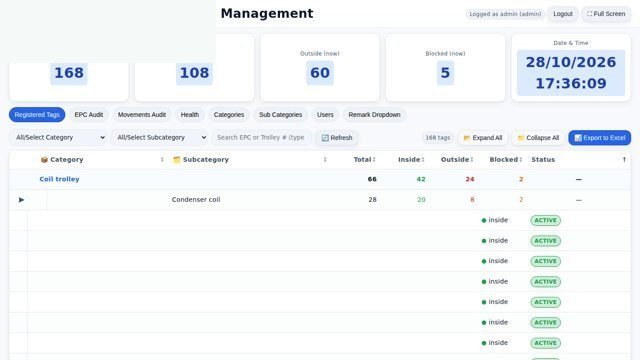
Every trolley, every gate, every movement — on its own.

Tagged trolleys and assets are read automatically as they pass a gate. MOS knows which way they moved, lights the tower lamp green, red or orange through the gate PLC, holds back blocked trolleys with a countdown and an approval workflow, and keeps an audit of every movement.
Blocked trolleys leave, unregistered ones enter, and the only audit is a guard's memory.
“Two readers per gate tell in from out; MOS lights the tower lamp through the PLC, holds blocked trolleys with a countdown and an approval, and keeps every movement.”
Drawn, not promised: the top row is a trolley fleet nobody can place until the month-end count. The bottom row is every trolley read at every gate, the lamp showing the move was allowed, and the record written without anyone typing.
Hover or tap a stage to see what is captured there.
Not a standalone tool — a product on the MOS platform, sharing one login, one set of people and roles, and one database with every other module. The lit layers are the ones this product uses; the signal path shows how data moves through them.
The honest map, drawn as one thread. Filled nodes are in the product today; outlined nodes are other MOS modules on the same platform; dotted nodes are roadmap and never represented as available until built. Hover a node.
Each card ends with the thing itself as it appears in MOS — not a description of it.
Step through it or let it play. Each step: who does it, on what, what is captured, and the check that guards it.
Every trolley, pallet or bin gets a UHF tag and a record: type, route, status.
The first reader sees the tag; the second confirms direction — in or out.
Is this trolley allowed through this gate in this direction? Is it blocked?
MOS drives the tower lamp: green to pass, red to hold, orange while awaiting approval.
A blocked trolley waits with a countdown; a supervisor approves or refuses on MOS.
Every movement is logged with time, gate, direction and decision.
A live dashboard shows every gate, lamp and the last reads; reader health is watched.
| Your ERP / Tally typically gives | RFID Asset & Trolley Tracking adds |
|---|---|
| A guard's memory of who left | Every movement logged with direction and time |
| A blocked trolley leaves anyway | Held at the gate with a countdown and approval |
| Unknown trolleys walk in | Unregistered tags caught and confirmed |
| A lamp someone switches by hand | The lamp driven by the decision, through the PLC |
Two UHF readers to tell in from out, and a tower lamp
A UHF tag on every trolley, pallet or bin — on-metal tags for metal
The gate PLC or a relay box over Modbus TCP
MOS Edge in the plant
What it connects to, where it runs and what it gives you — the short version your IT and your plant head both want.
Gate reading, direction, rules, blocked-trolley hold and approval, lamps via PLC, audit, reader health.
MOS Warehouse for what is on the trolley.
Reader placement and lamp wiring are tuned at the gate during installation.
Vehicle-level tracking — not represented as available.
Capabilities depend on the plant's process and what is connected at site. Nothing on this page is represented as available until it is built and running.
Instant lamp and reason at the gate
Where every trolley is now
Movements per gate and shift
Breaches and how fast they were closed
Two UHF readers to tell in from out, and a tower lamp.
A UHF tag on every trolley, pallet or bin.
The gate PLC or a relay box, and the MOS plant server.
One gate live with its lamp.
Register built; movement rules set per route.
Approvals, breaches and audit running plant-wide.
On-metal tags are used for metal assets; reader placement is tuned at the gate during installation.
It is flagged at the gate and must be confirmed before it is counted.
Know what is on every rack before anyone walks there.
See the module →A unique code on every unit, from the line to the distributor — and no one can fool you on quantity.
See the module →Every machine, live — and the real reason it stopped.
See the module →Tell us about your plant and what you want to see. We visit, connect one machine or station, and you watch your own data in MOS before anything is quoted.