MOS / Modules / Workforce
VISION POKA-YOKE BY MOS
Proof of concept

Vision Poka-Yoke

Every cycle checked against the right way of doing the job.

Teach by doingNo wearablesOK / SLOW / NGCycle vs standardOn an ordinary PC
See it on my machineSee the screen
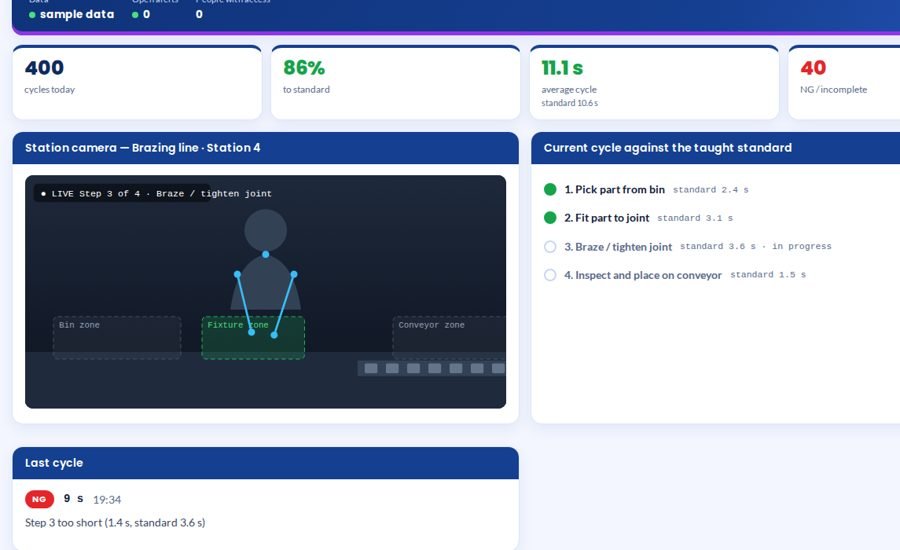
Vision Poka-Yoke screen 1 in MOS
The screen

What it looks like in MOS

The best operator does the job a few times in front of the station camera; MOS learns the steps, the zone each happens in, their order and their normal time. From then on every cycle is checked — a skipped step, steps out of order, a step done too quickly to be done properly, or a cycle that ran slow — and marked OK, SLOW, NG or INCOMPLETE with one plain reason.

Download the one-pagerSee it on my machine
Product positioning

A missed step is found at the customer

A screw not tightened, a step skipped, a brazing done too fast — invisible until the field complaint.

“The best operator does the job once in front of the camera; MOS learns the steps, order and timing, and checks every cycle — OK, SLOW, NG or INCOMPLETE with one reason.”
Today
Best operatorNew operatorRushed stepReworknoticed at rework
With Vision Poka-Yoke
Taught onceEvery cycle checkedOK · SLOW · NGSupervisorevery cycle, one reason

Drawn, not promised: the top row is a rushed or skipped step that surfaces as rework or a field return. The bottom row is the job taught once by the best operator and every cycle checked against it, with one plain reason when it is not.

End-to-end flow

5 connected stages

Hover or tap a stage to see what is captured there.

01

Set up

Zones drawn
  • Bins, tools, the part
  • Once per station
  • On the camera view
02

Teach

Do it once
  • The best operator
  • Steps, order, timing
  • The golden standard
03

Watch

Every cycle
  • Hands followed
  • No wearables
  • Ordinary PC
04

Judge

One reason
  • OK / SLOW / NG
  • INCOMPLETE
  • Missed, wrong order, too fast
05

Report

Per shift
  • Every miss and why
  • Cycle time vs standard
  • Per operator / station
Continuous threadSet up→Teach→Watch→Judge→Report
Part of the platform

Vision Poka-Yoke runs on MOS

Not a standalone tool — a product on the MOS platform, sharing one login, one set of people and roles, and one database with every other module. The lit layers are the ones this product uses; the signal path shows how data moves through them.

  • MOS Edge runs inside the plant — interlocks and screens keep working if the internet does not.
  • MOS Central is a one-way mirror for head office and every plant in one view.
  • Your IT never opens an inbound port.
MOS CentralEvery plant, one view
MOS EdgeYour plant serverin use
MOS CoreThe operating layerin use
MOS ConnectMachine connectivity
MOS VisionAI on the linein use
Core engine & extensions

What is core, what extends it, what is not claimed yet

The honest map, drawn as one thread. Filled nodes are in the product today; outlined nodes are other MOS modules on the same platform; dotted nodes are roadmap and never represented as available until built. Hover a node.

● Core

● Core — in the product today○ Extension — another MOS module◌ Roadmap — not claimed
Native engine

Core functionalities

Each card ends with the thing itself as it appears in MOS — not a description of it.

Teach

By doing

  • The best operator does the job
  • Steps, zones, order learned
  • Normal time per step
  • No programming
Watch

Hands, not wearables

  • One camera at the station
  • Ordinary PC
  • Every cycle
  • Live
Judge

One plain reason

  • Skipped step
  • Wrong order
  • Done too fast
  • Cycle too slow
Report

Per shift

  • OK / SLOW / NG / INCOMPLETE
  • Every miss and why
  • Cycle time vs standard
  • By operator and station
Operational journey

6-step digital thread

Step through it or let it play. Each step: who does it, on what, what is captured, and the check that guards it.

Step 1 / 6
Step 1 · Setup

Draw the zones

The bins, tools and the part are marked once on the camera view.

WhereStation setup
CapturedZones
Guard / interlock—
● live in MOS
Where it sits

Your ERP or Tally runs the books. This adds the ground truth.

Your ERP / Tally typically givesVision Poka-Yoke adds
An SOP on the wallThe standard taught by doing it once
Audits a few times a shiftEvery cycle checked
A miss found in the fieldA miss flagged at the station, with the reason
Wearables and sensors on the operatorOne camera, hands followed
Hardware & connectivity

Works with what a plant already has

Camera

One camera at the station — a phone camera for trials

Compute

An ordinary PC or laptop at the station

Server

MOS Edge for the reports

Nothing on the operator

No wearable, no sensor

At a glance

The spec

What it connects to, where it runs and what it gives you — the short version your IT and your plant head both want.

ReadsOne camera at the station
Runs onMOS Vision — an ordinary PC at the station
Needs on siteA camera and a PC at the station
OutputsOK/SLOW/NG/INCOMPLETE per cycle with one reason, cycle time vs standard, shift report
Licensed byPer station
Capability transparency

What is built, what extends, what is not claimed

Core — today

Zone setup, teach-by-doing, cycle checking with one reason, cycle time, shift report.

Extension

MOS OEE at the same station.

Integration-dependent

Camera placement and lighting set per station.

Roadmap

Automatic line stop on NG — not represented as available.

Capabilities depend on the plant's process and what is connected at site. Nothing on this page is represented as available until it is built and running.

What you get

5 outcomes

Teach the standard by doing it No wearables OK / SLOW / NG per cycle Cycle time vs standard Shift report of every miss
Who uses it

Everyone sees what their job needs

Operator

Immediate feedback on each cycle

Supervisor

Which station and which step is being missed

Industrial engineering

Real cycle times against the standard

Quality

Proof that critical steps were done

On site

What is needed in your plant

At the station

One camera that sees the operator's hands and the work area.

On site

A PC or laptop at the station; no sensors on the person.

To teach

Your best operator doing the job a few times.

Rollout

From the first day to the first month

Day one

Camera and zones

Camera placed; bin, fixture and conveyor zones marked.

Week one

Standard taught

Steps, order and normal time learned from the best operator.

Month one

Every cycle checked

Results and reasons live at the station and in the shift report.

Questions

Asked about Vision Poka-Yoke

Is this monitoring people?

It checks the job, not the person: steps, order and time against the standard your own best operator set.

What happens when the job changes?

The new way is taught again the same way, in a few cycles.

Works with

The rest of MOS

On your own machine

See it on your own machine.

Tell us about your plant and what you want to see. We visit, connect one machine or station, and you watch your own data in MOS before anything is quoted.

  • A plant visit to see the line and the problem
  • One machine or station connected as a proof of concept
  • Your own data, live, on MOS screens
  • Scope, modules and timeline agreed in writing only after that
Thank you — request received.We will call you shortly to plan the visit.